The calorie answer belongs to a specific dated source row, not to every Harvest Bowl that has ever appeared on a menu. Sweetgreen’s menu page displayed 740 calories when it was captured on July 10, 2026, while the complete July nutrition-guide row lists 760. This site keeps the 760-calorie row because it supplies the full ten-field nutrition panel used by the Sweetgreen Calorie Calculator.
A 20-calorie difference is small enough to overlook but important enough to label. It may reflect publication timing, a recipe update, or another source change that the captured pages do not fully explain. The safe conclusion is that 760 calories describes this site’s dated guide row. Check the current ordering experience when the exact restaurant recipe matters.
Harvest Bowl nutrition facts in this snapshot
The prepared-product row represents the named bowl as a complete item. It lists 760 calories, 42 grams of total fat, 9 grams of saturated fat, zero grams of trans fat, 70 milligrams of cholesterol, 1,300 milligrams of sodium, 60 grams of carbohydrates, 10 grams of fiber, 12 grams of sugar, and 40 grams of protein.
| Field | Harvest Bowl value | Field | Harvest Bowl value |
|---|---|---|---|
| Calories | 760 | Protein | 40 g |
| Total fat | 42 g | Saturated fat | 9 g |
| Carbohydrates | 60 g | Fiber | 10 g |
| Sugar | 12 g | Sodium | 1,300 mg |
Those figures work together. Someone comparing entrées may start with calories, then notice that this row also provides 40 grams of protein and 10 grams of fiber. Another reader may pay closer attention to fat or sodium. The table does not decide which field should matter most; it keeps the complete source row visible so the comparison is not reduced to one number.
What is included in the complete Harvest Bowl row?
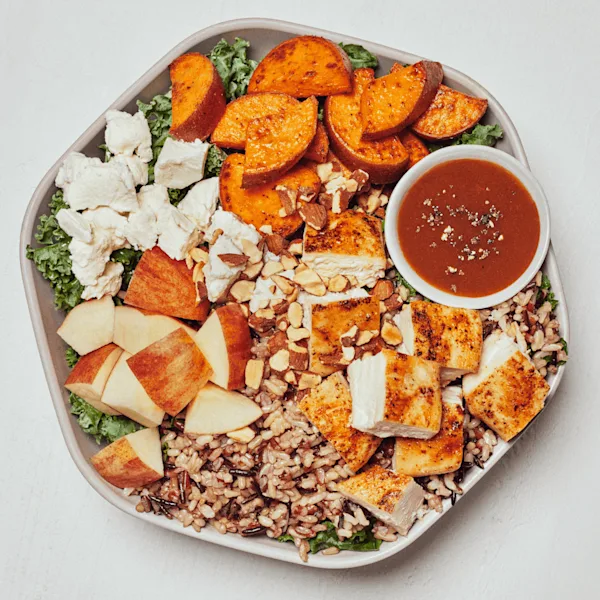
The local menu description lists roasted chicken, roasted sweet potatoes, apples, goat cheese, roasted almonds, wild rice, organic shredded kale, and balsamic vinaigrette. The 760-calorie value applies to that prepared combination as represented by the nutrition guide. It is not the calorie count for the chicken alone, the dressing alone, or a bowl with unspecified substitutions.
Several components help explain why the bowl is more substantial than a plain greens-and-chicken salad. Wild rice and sweet potatoes contribute much of the carbohydrate base. Goat cheese, almonds, and vinaigrette add richness, while chicken contributes to the protein total. Kale and apples add volume and texture. This description is useful for understanding the row, but it should not be used to reverse-engineer the total from custom ingredient servings.
A prepared product and a Create Your Own recipe are different source objects. The guide to Sweetgreen bowl calories explains why a named bowl should remain one calculator line. Adding a Harvest Bowl and then adding presumed portions of chicken, rice, almonds, cheese, or dressing would count parts of the recipe twice.
How the Harvest Bowl compares with other prepared bowls
Within the same local dataset, the Harvest Bowl’s 760 calories place it above the 680-calorie Crispy Rice Bowl and the 510-calorie Chicken Pesto Parm, and just below the 765-calorie Fish Taco bowl. These are comparisons between complete prepared rows. They do not imply that one item is universally lighter after substitutions or that the products are nutritionally interchangeable.
The protein comparison also adds context: Harvest Bowl lists 40 grams, Crispy Rice Bowl lists 33 grams, Chicken Pesto Parm lists 38 grams, and Fish Taco lists 34 grams. Sodium moves differently: Harvest Bowl lists 1,300 milligrams, while those three rows show 1,225, 1,560, and 1,090 milligrams respectively. Browse the Sweetgreen menu calorie directory when you want to compare the current local prepared-product rows side by side.
How to calculate a modified Harvest Bowl
If the order exactly matches the named prepared product, add the Harvest Bowl once. If you add a genuinely separate side, drink, dessert, or extra portion, add that item as another line. This keeps the meal summary transparent: the original prepared bowl remains intact, and the separate addition is visible instead of being hidden inside an unexplained estimate.
Substitutions require more caution. Removing an ingredient does not always mean that subtracting one custom-table serving will reproduce a restaurant’s revised total. The prepared row and custom ingredient table can use different recipe portions and rounding. For a heavily changed order, build the ingredients you actually intend to select in Create Your Own and treat the result as a custom estimate rather than claiming it is an official modified Harvest Bowl total.
- Match the starting item. Select the prepared Harvest Bowl only when the named recipe is the correct baseline.
- Read the active source note. Keep the 740-versus-760 snapshot difference in view instead of mixing values from two surfaces.
- Add only real extras. A second dressing or side belongs on a separate line only when it is actually part of the order.
- Use custom mode for a different build. Select the listed ingredient portions and quantities that best represent the changed bowl.
- Review the whole panel. Recheck calories, protein, carbohydrates, fat, fiber, sugar, and sodium after every change.
Sodium, allergens, and source limits
The Harvest Bowl row lists 1,300 milligrams of sodium. That figure belongs to the complete prepared product, so evaluating only the chicken or vinaigrette would miss the rest of the recipe. The site’s Sweetgreen sodium guide explains how prepared rows and custom portions should be counted without applying a personal medical target.
The local description tags milk, meat, and tree nuts, reflecting goat cheese, chicken, and roasted almonds in the represented recipe. An allergen tag cannot guarantee safety because recipes, suppliers, substitutions, shared equipment, and cross-contact practices can change. Review the site’s nutrition source guide for the dataset boundaries and verify sensitive details with Sweetgreen’s current Nutrition + Allergens Guide.